SEO · Cashin Media
How Long Does SEO Take? A Realistic Timeline and What to Measure
By the Cashin Media team ·
If you have invested in your website or content, it is natural to ask when you might see a change. To gauge progress, check whether pages appear in Search, bring visits and lead to inquiries.
Google says changes may take hours to months to appear in Search and generally suggests waiting a few weeks to assess their effect. This is guidance, not a ranking or business promise; measurement tools may lag.
This guide covers expectations and signs to check—not a fixed date for a particular position.
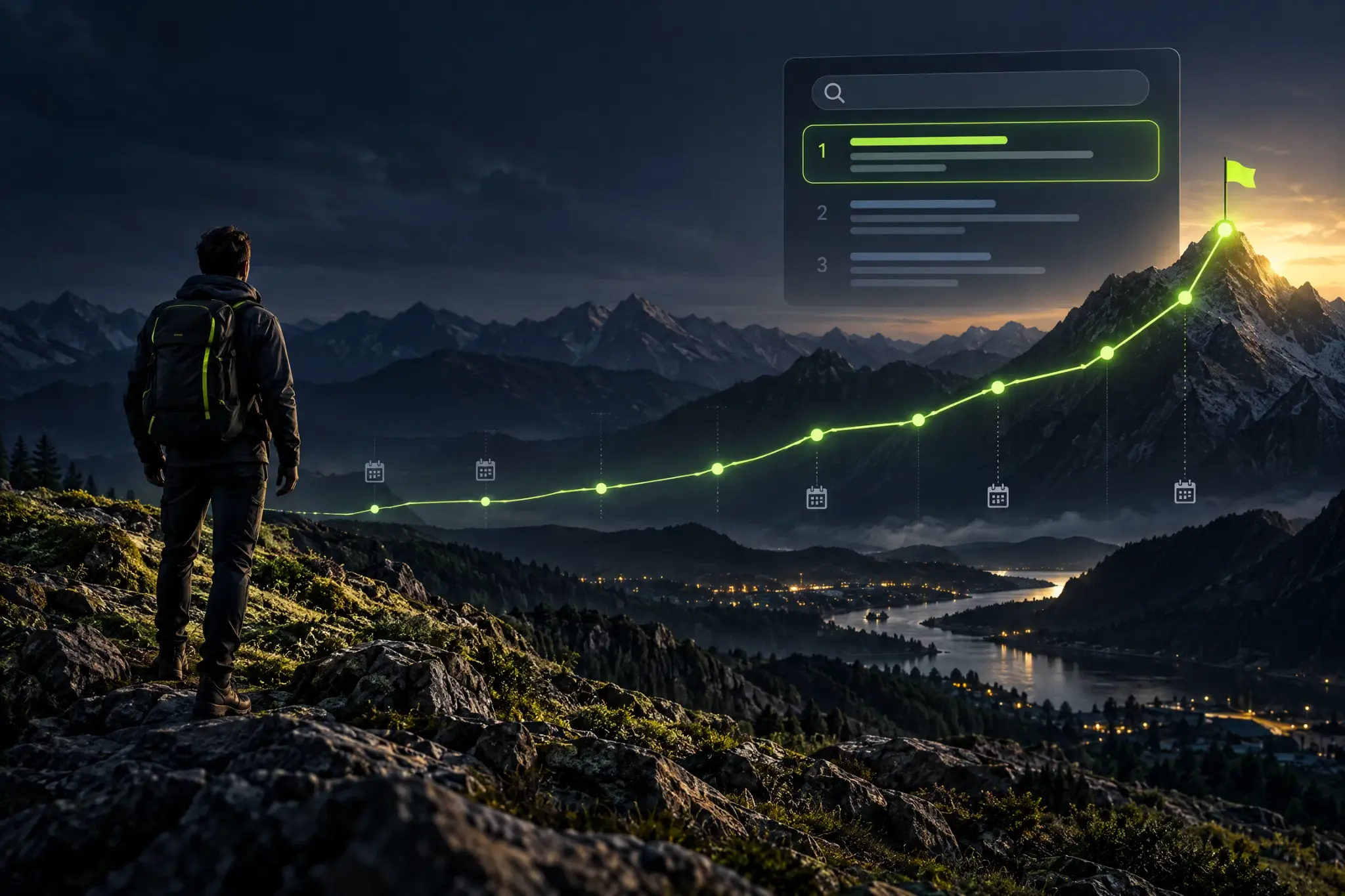
An illustrative timeline—not a promise
These are possible milestones, not promises. Timing varies with site condition, market, competition, the change and implementation pace. Stages overlap: established pages may earn impressions while new ones are discovered.
| Stage | What may happen | What to monitor |
|---|---|---|
| Starting point | Technical review, service and search-intent research, and page planning | Page accessibility, index status, queries and baseline data |
| After changes | Google may discover and crawl changed or newly published URLs | Crawl and URL Inspection evidence; this is not a ranking |
| Later | Pages may be included in the index and begin receiving impressions | Index status, impressions and queries in Search Console |
| Learning and improving | Click and traffic data accumulate, helping assess whether the right people arrive | Clicks, organic visits, inquiries and their quality |
| Over time | Content, structure and investment are adjusted to demand and competition | Trends and business outcomes alongside effort and cost |
Provider timelines are commercial estimates, not official Google schedules. Google says changes may take a few hours to several months to be reflected and generally suggests waiting a few weeks to assess impact; this predicts no specific result for a site.
What affects the pace
- Starting conditions: New, technically troubled and established sites start in different situations; history alone does not guarantee success.
- Competition and intent: A local query faces different competition than a broad national one; demand changes matter too.
- Content quality and fit: Content should answer a real need and fit the page and service.
- Technical implementation: Internal links, crawl accessibility, clear URLs and usability help people and search engines reach content.
- Ability to implement and learn: Progress depends on implementing fixes and learning from measures rather than waiting for one result.
- External factors: Competition, seasonality, demand and search updates alter results.
No formula predicts an exact number of weeks. Ask which pages and markets are included, what work and measures are planned, and when the plan will be reviewed. A credible answer acknowledges uncertainty and factors outside the provider's control.
An Israeli business should assess relevant Hebrew searches; a U.S.-focused company should assess its English pages and market separately. Separate language URLs and hreflang can help Google understand page audiences, but do not guarantee visibility.
A four-stage evidence ladder: URL to business value
Use a ladder, not one metric. Each stage may support the next but does not prove it. Check the right source and note what the evidence cannot establish.
- 1. Discovery, crawling and retrieval: Check internal links, crawl reports and Search Console URL Inspection to see whether Google can reach a URL and what it reports about it. A request for indexing asks Google to crawl; it is not a command, a promise of immediate crawling or confirmation that the page will be indexed. A successful crawl does not prove the page was selected for the index, is relevant to a query or ranks.
- 2. Indexing and canonical selection: Use URL Inspection and indexing reports to see whether Google reports a page as indexed and, when available, its selected canonical. Duplicates, redirects, noindex directives and similar content can affect selection. Indexing does not prove visibility or ranking.
- 3. Search impressions and clicks: The Search Console Performance report provides impressions, clicks, CTR and average position across available dimensions such as query, page, country and device. An impression means a result was counted under the reporting rules; it does not prove a user noticed it or visited the business. A click is a transition from a result, not a qualified visit or lead. Data is subject to latency, privacy, aggregation and sampling; some queries are not shown, and totals across reports may not match exactly. Compare meaningful periods and trends, not a single day.
- 4. Relevant traffic, leads and business value: In analytics, examine visits attributed to organic search, landing pages and predefined actions; in the lead system, review calls, forms, orders and their quality. Confirm that measurement and attribution are configured sensibly, and have sales teams record a lead source where possible. Traffic does not prove SEO alone caused a sale: demand, brand, advertising, seasonality and follow-up quality all matter. Look for a sustained contribution over time, not a success story based on one case.
The ladder asks: Can Google reach and index the page? Does it appear and earn clicks? Do relevant visitors produce outcomes? Impressions without clicks suggest reviewing query fit and the result; clicks without inquiries suggest checking the landing page, offer, experience and conversion tracking—not assuming a ranking problem.
A measurement rhythm that avoids daily noise
No review frequency or change threshold fits every site. Set a cadence based on data volume, seasonality, sales cycle and site changes. Frequent checks can catch technical failures, but daily fluctuations do not establish SEO success.
- Before work begins: Record a baseline, major site changes, countries and languages, business pages, conversions and data sources. Make sure measurement excludes internal testing and does not count the same event twice.
- As work proceeds: Check availability and look for unusual errors, URL changes or blocking. After an important publication or fix, you may request crawling, but repeated requests are not necessary and should not create an expectation of an immediate result.
- At a periodic review: Compare time windows that make business sense, using comparable periods when seasonality matters. Review impressions, clicks, landing pages, traffic and conversions together; segment by country, language and service so differences are not hidden.
- When a change appears: Check for site updates, demand shifts, tracking issues or presentation changes. Verify the signal where possible, document a hypothesis and wait for a suitable data window before acting again.
- At a working meeting: Summarize what was completed, what was learned, what remains unknown and the next action. Connect the work to a measure that can be checked without presenting correlation as proof of causation.
Distinguish two kinds of waiting: Google says site changes can take time to affect Search; Search Console data may separately be delayed or limited by privacy and reporting methods. A reporting gap does not prove there was no traffic, and newly arrived data does not prove yesterday's change already worked.
SEO and paid advertising can work together
Paid ads can bring traffic while active; they do not replace useful content and organic visibility. A business may use both according to budget, urgency and goals.
Customer conversations and campaign data may inform content priorities, but ad performance does not guarantee organic rankings. Report channels separately.
What about GEO and AI answers?
AI-search readiness rests on crawlable pages, useful answers and clear evidence. State who the service is for and whether delivery is remote; do not imply an office or service area that does not exist. No file or markup guarantees an AI citation.
AI citations vary and do not guarantee traffic or leads. Measure verifiable outcomes, distinguishing visibility, visits and business value.
Spot promises that are not well supported
- A guaranteed first place or fixed date: No provider controls the algorithm or every search result. Ask for a conditional forecast and an explanation of uncertainty, not a guarantee.
- Reports that show rankings only: Ask to see the path from crawling and indexing to impressions, clicks, traffic quality and business outcomes.
- Opaque activity: Request an account of content, technical fixes, link sources and unknowns.
- No review points: Set review milestones to discuss learning and next steps.
- Measurement is ignored: Before promising growth, check that conversions, calls and inquiries are measured in a dependable way.
A responsible commitment describes work, measures and review points, not outcomes outside a provider's control. A rising chart may reflect tracking changes or irrelevant searches.
Sources and further reading
Google's sources explain Search processes and tool limits: crawl requests do not guarantee indexing, Search Console reporting has limits, and international guidance covers language and regional versions. These are not forecasts for an individual site.
- Google Search Central — SEO Starter GuideSEO fundamentals and guidance on creating useful, people-first content.
- Google Search Central — Ask Google to recrawl URLsHow to request crawling and what a request does not guarantee.
- Google Search Central — How Google Search worksAn overview of crawling, indexing and serving results.
- Google Search Console — URL Inspection toolInspect information about Google's version of a URL and its indexing.
- Google Search Console — About Search Console dataHow data is collected and updated, and why it has limitations.
- Google Search Central — Managing multi-regional and multilingual sitesGuidance on organizing language and regional versions, including hreflang.
Frequently asked questions about SEO timelines
When should I expect the first result?
There is no fixed date. Crawling, indexing, impressions, clicks and business outcomes are different stages. Google says changes may take a few hours to several months to be reflected and suggests waiting a few weeks to assess impact; neither guarantees a result.
Does a crawl request mean the page will rank?
No. A request asks Google to crawl a URL; it does not guarantee when it will be crawled, whether it will be indexed or how it will appear in results.
How can I tell whether SEO is progressing?
Review the stages: access and crawling, indexing and canonical selection, impressions and clicks, then relevant traffic and inquiries. Every data source has limitations.
Why is Search Console data not current?
Reports are not necessarily real time, and may involve latency, aggregation and privacy limits. The time data reaches a tool is not the time SEO takes to affect Search.
Can anyone guarantee the top Google position?
Not reliably. A provider can commit to a transparent process and measurement, but cannot control results or competitors.
Should a business targeting Israel and the U.S. combine its data?
It is useful to segment by country, language and page. Hebrew and English versions may serve different audiences and intent; well-organized language URLs and hreflang can help Google understand the relationship, but do not guarantee visibility.
Does GEO require a magic file or solution?
No. Start with crawlable pages, useful content, clear answers and reliable information. No file or action guarantees a citation in an AI system.
What can I do while SEO develops?
Keep improving pages and user experience, verify inquiry tracking, and consider whether paid advertising fits the immediate need and budget.
Terms to know
- Crawling
- The process by which Google discovers a URL and accesses its content. Crawling does not guarantee indexing or ranking.
- Indexing
- Including content in the collection from which Google may select results to show.
- Canonical URL
- The URL Google identifies as representative of a group of similar or duplicate pages; its selection may differ from the site's stated preference.
- Impression
- A result appearance counted under Google's performance-reporting rules; it does not prove a user noticed it.
- CTR
- Click-through rate: clicks divided by impressions under a report or measurement system's definitions.
- hreflang
- A signal that identifies language or regional page versions; it does not guarantee ranking or visibility for a particular audience.
- GEO
- A term for optimization for generative answer engines; the foundations remain useful content that is clear and crawlable.
Build an SEO plan you can understand and measure
Review the starting point, follow the evidence from crawling to business value, and decide when to revisit the plan. That lets you learn from data without promising a ranking, date or outcome no one controls.